
How to Win at Krillocity: Tips for Naming More Answers, Faster
Every Krillocity prompt asks two questions at once: how many answers can you name in 30 seconds, and how rare can you make them? Psychologists have been timing people naming things since the 1940s, and what they found reads like a race plan.
Introduction
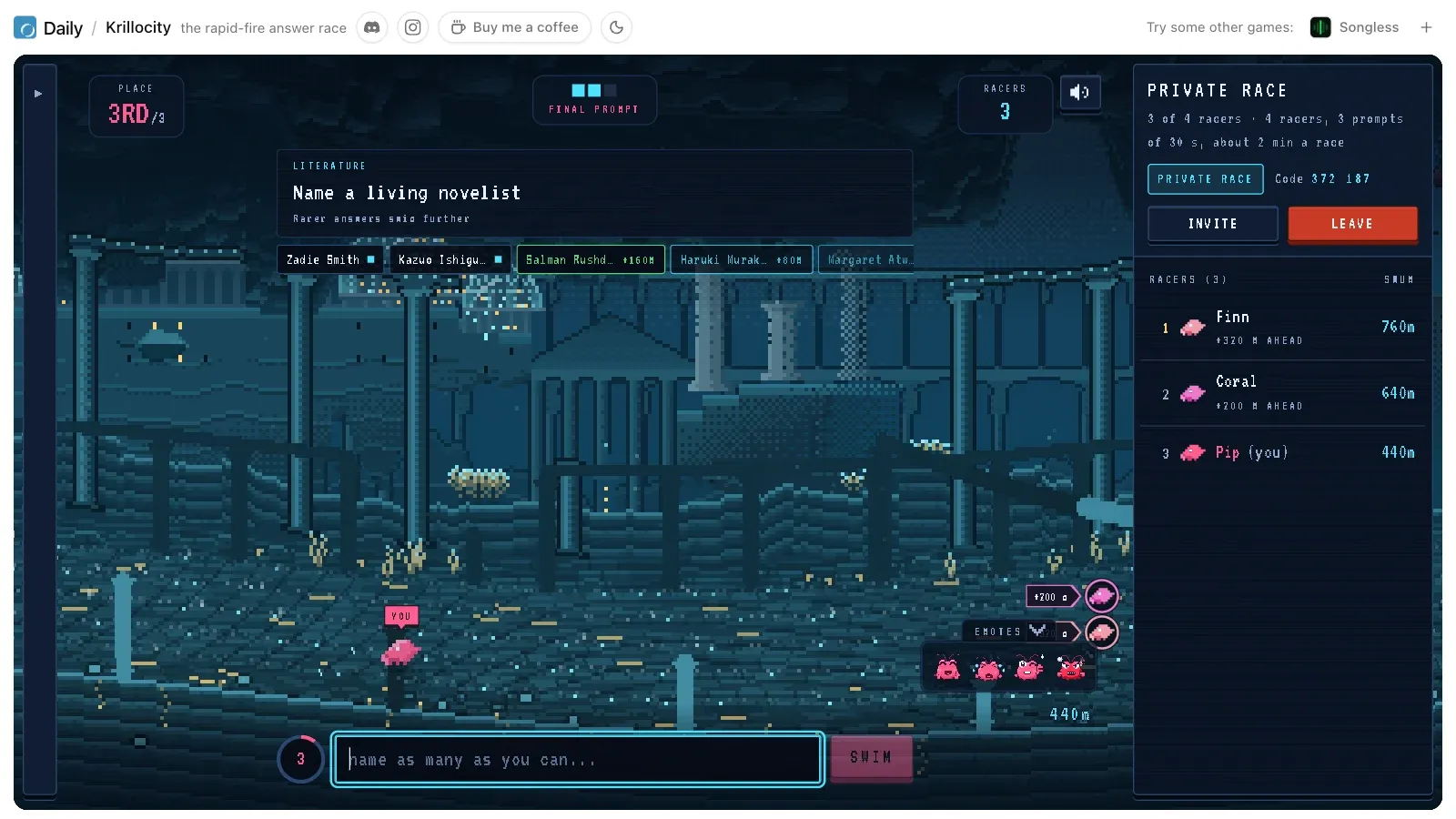
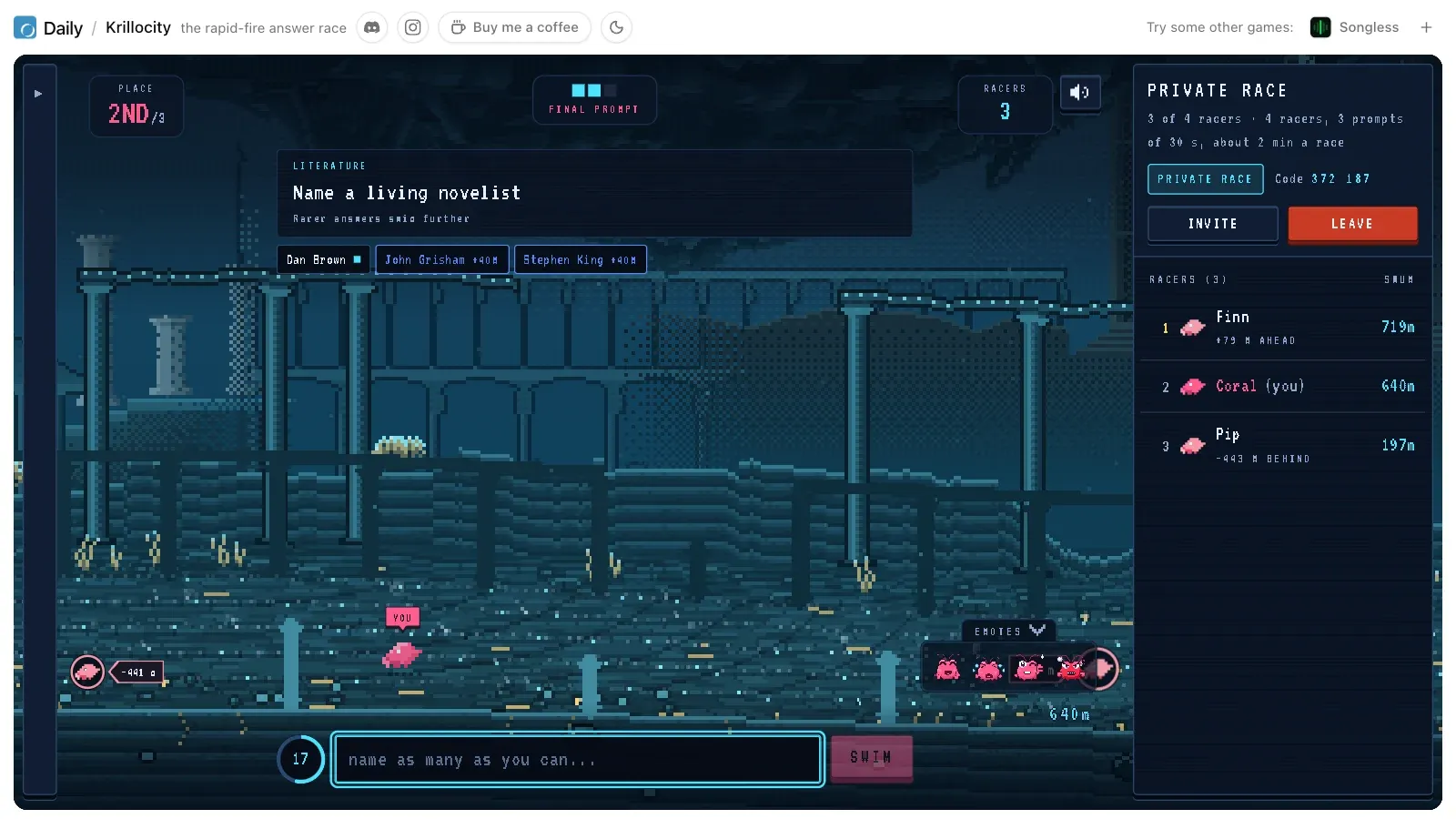
Krillocity gives you 30 seconds to name as many answers to a prompt as you can. Each one swims your krill forward: 40 m for the answer everybody gives, up to 1,000 m for one nobody does. So on every prompt you choose between typing easy answers fast and slowing down to find rare ones.
Psychologists have studied this exact task, naming things in a category against a clock, for more than 80 years. This guide covers what the scoring says, what the research says, and how to use both.
First, Do the Arithmetic
The tiers double as they go: Plankton 40 m, Too Clever 80 m, Schooler 160 m, Rare 320 m, Deep Cut 640 m and One in a Krillion 1,000 m. Two sums follow from that.
- One Rare answer beats five Plankton answers. Five common answers swim 200 m. A single answer at Rare swims 320 m.
- But five Plankton answers beat a blank. A racer who spends 30 seconds hunting for one perfect answer and does not find it swims nothing.
So a good prompt usually looks like a burst of easy answers plus a few that reach further. Something like five Plankton, two Too Clever, a Schooler, a Rare and a Deep Cut comes to 1,480 m in ten answers. The single Deep Cut is worth more than the other nine answers together, and those nine are still most of the work.
What the Research Says
The easy answers come first, for everyone
In 1944 W. A. Bousfield and C. H. W. Sedgewick timed people naming members of categories and plotted how many names had come out at each moment. The curve was the same every time: steep at the start, then flattening as the easy answers ran out. Most of what a person will name in a minute arrives early.
That is why the first answers you think of score least. Everyone in the race is on the same curve, and the start of everyone's curve is the same handful of answers. We counted which answers do this most often in Titanic, Shrek and Paris: the answers everyone gives first.
People name in clusters, and switch when a cluster runs dry
In 1997 Angela Troyer, Morris Moscovitch and Gordon Winocur split category naming into two skills. Clustering is producing a run of answers from one corner of a category: farm animals, then pets, then birds. Switching is jumping to a new corner when the current one stops giving. Both add to how many answers a person names, and switching is what gets someone going again once the obvious answers are spent.
About twenty a minute is normal
Norms published in 1999 by Tom Tombaugh, Jean Kozak and Laura Rees put a typical adult at roughly twenty animals in a minute, with the count falling with age and rising with years of schooling. A Krillocity prompt is half that time, and every answer has to be typed as well as thought of, so reaching double figures on a prompt is good going. There is more on the science in how many animals can you name in a minute.
A Race Plan in Five Steps
- Pick your corner during the count-in. Every prompt shows for 2 seconds before its clock starts. Use them to decide where you will begin, so the first answer is going in the moment the clock runs.
- Empty the obvious answers in a burst. They are only 40 m each, but they are the fastest metres on the clock, and every rival is collecting them too. Keep them short: Enter sends each one and clears the box, so you never need to touch the screen.
- Switch the moment you stall. When the answers stop coming, change corners instead of waiting: tropical fruit to berries, capitals to islands, pets to farm animals. A fresh corner gives a fresh run.
- Hunt rare answers late. By the last ten seconds the easy answers are gone for everybody, and that is when the answer only you would think of is worth looking for.
- Send before the buzzer. An answer counts only once it is sent. A half-typed word when the clock hits zero swims nowhere.
Mistakes That Cost Metres
- Waiting for the perfect answer. Thirty seconds is short. A racer who names only rare answers names too few of them.
- Typing the same answer twice. Plurals and alternative spellings count once, so the second one is time thrown away.
- Guessing wildly. An answer the bank does not know is checked by an AI judge, which looks at up to 12 of them from each racer on each prompt. Once 3 are refused, it stops looking at new ones for the rest of that prompt. Answers you are not sure of spend that allowance, and answers the bank knows still count either way.
- Arguing with a refusal. A refused answer costs only the seconds it took to type. Move on to the next one.
Practising Away From the Race
Krillocity draws its prompts from Krillion Unlimited and uses the same judge. There you give one answer per prompt, and the rarer it is, the deeper you dive. A few dives there are a good way to learn which answers sit at the bottom of a bank, and our Krillion Unlimited tips cover finding them.
The race itself is the best practice, though. If you are new to it, watch one race prompt by prompt first, then line up for one.
About the author
Timmothy is a student who has loved puzzle games since childhood and likes digging into how they actually work. He writes about the science and history behind the games on Daily.