
Every Zone in Noillirk, From the Forest Pond to the Edge of Everything
Noillirk has 69 zones. The first 52 follow real altitudes and distances, from a pond on the forest floor to the cosmic microwave background, 46.5 billion light years out. The last 17 go where no telescope can. Here is every one, and the points it takes to reach it.
Introduction
In Noillirk your score is a height. Every point lifts your krill ten metres of climb, and each zone maps its stretch of climb onto a real span of sky or space, so the altitude in the corner of the screen is a true one, right up to the edge of the observable universe. A classic climb of seven prompts reaches 14 kilometres at most. Everything above that belongs to Endless mode and to long sittings in the multiplayer rooms.
Below is every zone in order, with the points you need to reach it, the real altitude it covers, and the game's own line about it. If you are new to the scoring, start with how to play Noillirk.
The Forest and the Weather
The first sixteen zones are the atmosphere, from the ground to the edge of space. The time of day follows your altitude rather than your clock, so everyone at the same height sees the same sky: a bright morning in the forest, sunset around cruising altitude, and night above it.
- 1. The Forest Floor, from 0 points, ground level to 4 m. A pond in the moss, deep in a green wood. Every climb starts here.
- 2. The Understory, from 40 points, 4 m to 18 m. Up the trunks and between the branches, where the light comes down in shafts.
- 3. The Canopy, from 80 points, 18 m to 45 m. The roof of the forest: leaves on every side, then sunlight on top of them.
- 4. The Valley, from 120 points, 45 m to 830 m. The forest falling away below, the lake and the town, and the mountains beyond.
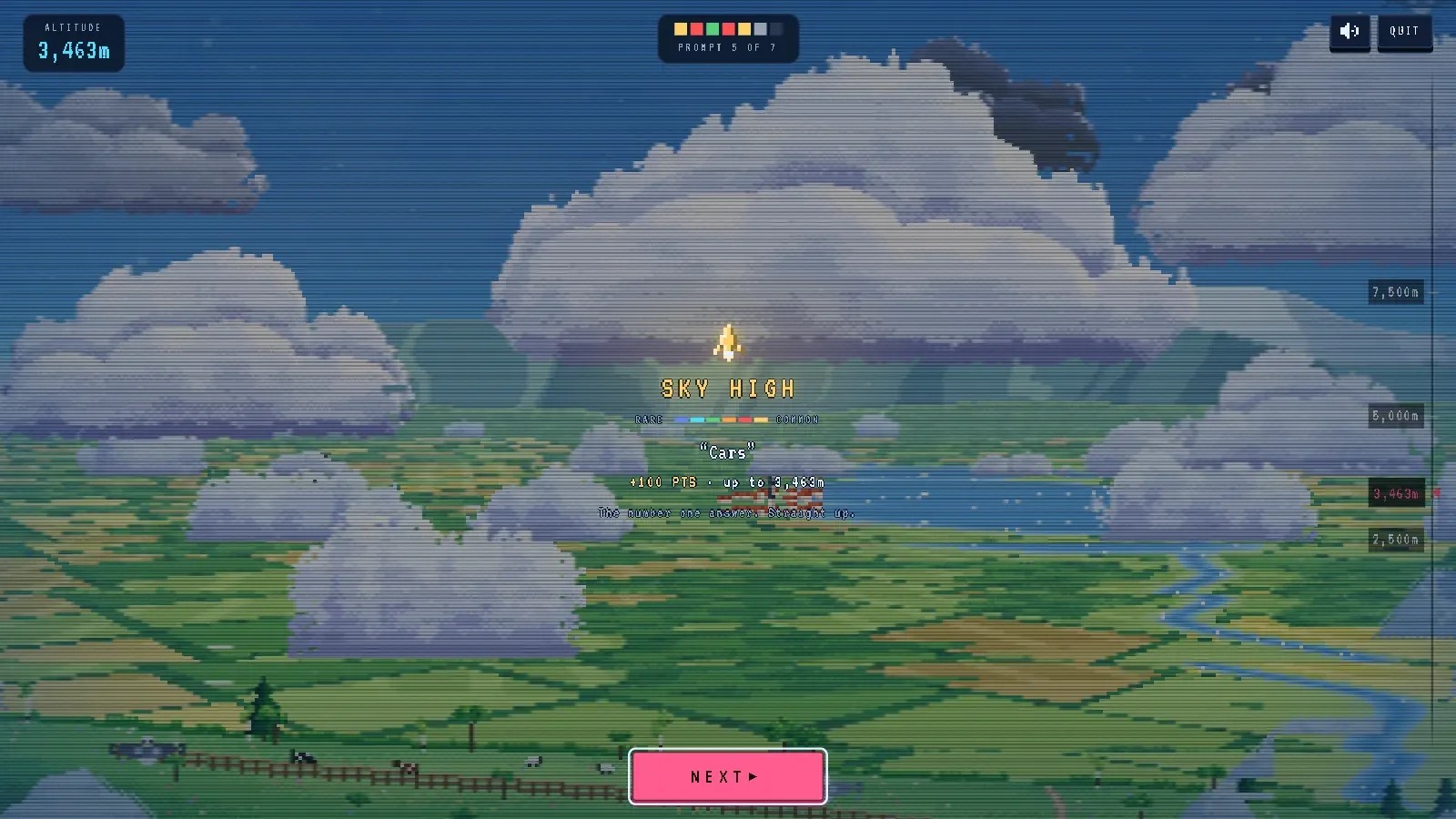
- 5. The Low Clouds, from 230 points, 830 m to 2,000 m. The first clouds thick enough to lose the ground behind.
- 6. The Mountains, from 305 points, 2,000 m to 5,000 m. Rock that pushed higher than the clouds around it.
- 7. The Thunderhead, from 385 points, 5,000 m to 8,000 m. Up the inside of a thunderstorm: rain under it, lightning all through it, the anvil on top.
- 8. The Death Zone, from 465 points, 8,000 m to 9,500 m. Above this line the air can no longer keep a person alive for long.
- 9. Cruising Altitude, from 550 points, 9,500 m to 11 km. Where an airliner spends most of its life.
- 10. The Jet Stream, from 635 points, 11 km to 15 km. A river of wind near the top of the weather.
- 11. The Lower Stratosphere, from 710 points, 15 km to 30 km. The ozone layer thickens here. It filters the worst of the Sun.
- 12. The Upper Stratosphere, from 870 points, 30 km to 50 km. Thin enough now that a suit has to hold the pressure for you.
- 13. The Stratopause, from 1,040 points, 50 km to 65 km. The stratosphere's ceiling. The air keeps thinning above it.
- 14. The Mesosphere, from 1,220 points, 65 km to 80 km. Most of what falls in from space burns out no lower than this.
- 15. The Noctilucent Clouds, from 1,410 points, 80 km to 90 km. Ice on dust from space, lit by a sun that has already set below.
- 16. The Mesopause, from 1,600 points, 90 km to 100 km. The coldest place in the whole atmosphere, and the quietest.
A perfect classic climb, seven Sky High answers, is 700 points. It ends in the Jet Stream, 14 kilometres up, above the airliners and just past the top of the weather.
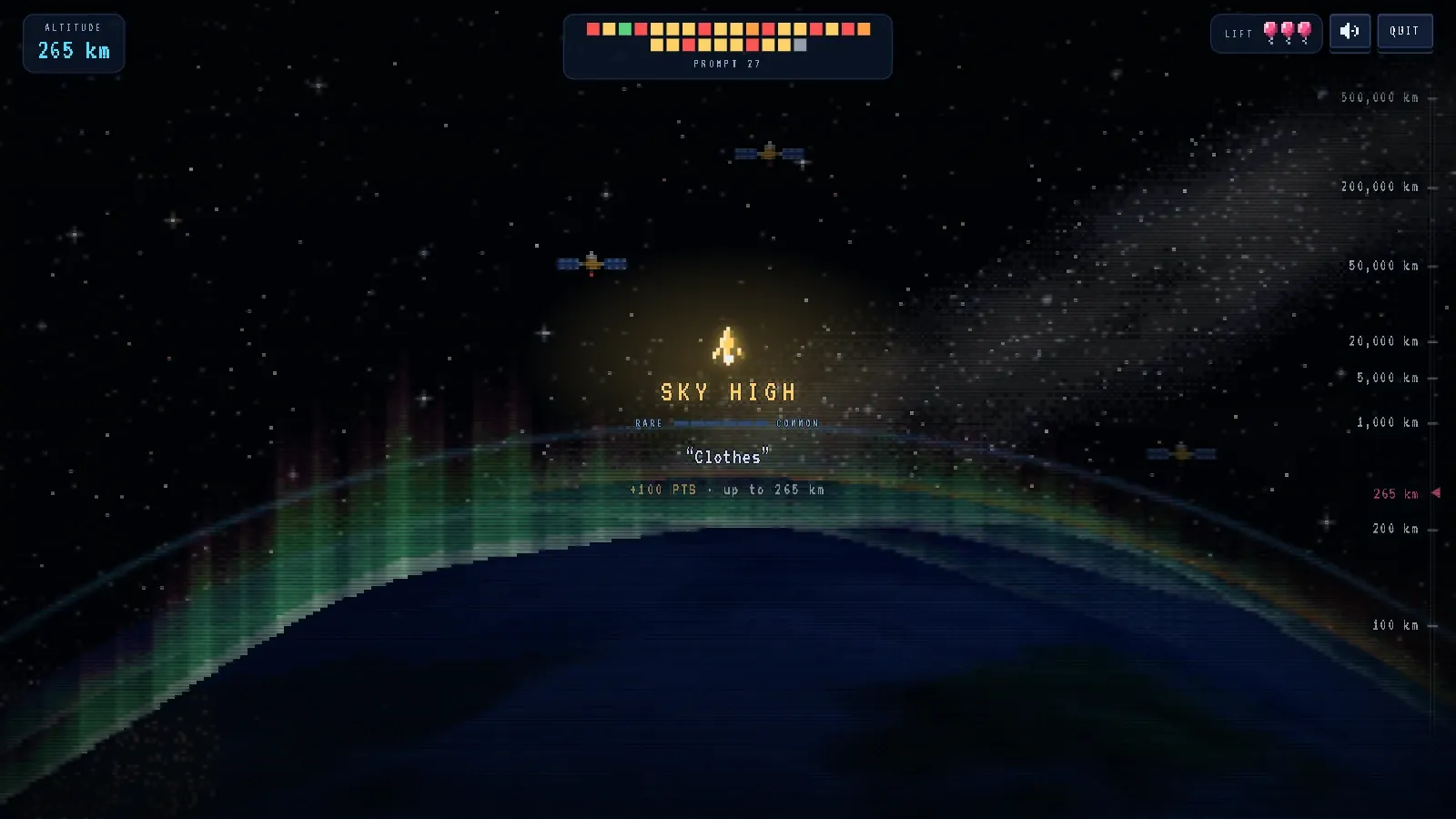
Into Space
Space begins at the Kármán line, 1,800 points up: two and a half perfect classic climbs back to back. From there the climb follows real distances, through orbit and out past the Moon, then to each planet at its closest to Earth and on to the edge of the Sun's reach. Past the Sun the distances are in AU, astronomical units: one AU is the Earth's average distance from the Sun, about 150 million kilometres.
- 17. The Kármán Line, from 1,800 points, 100 km to 180 km. The internationally agreed edge of space. Air, technically, ends here.
- 18. The Aurora, from 2,050 points, 180 km to 330 km. Solar particles hitting the top of the air, and the air lighting up.
- 19. Low Earth Orbit, from 2,300 points, 330 km to 2,000 km. The whole of human spaceflight has happened at about this height.
- 20. The Van Allen Belts, from 2,460 points, 2,000 km to 20,200 km. Two donuts of charged particles, trapped by the planet's own magnetism.
- 21. GPS Orbit, from 2,640 points, 20,200 km to 35,786 km. The constellation everyone's phone is quietly listening to.
- 22. Geostationary Orbit, from 2,820 points, 35,786 km to 100,000 km. Far enough now to see the whole Earth as one circle.
- 23. Cislunar Space, from 3,010 points, 100,000 km to 350,000 km. The space between here and the Moon. Mostly empty, and quiet.
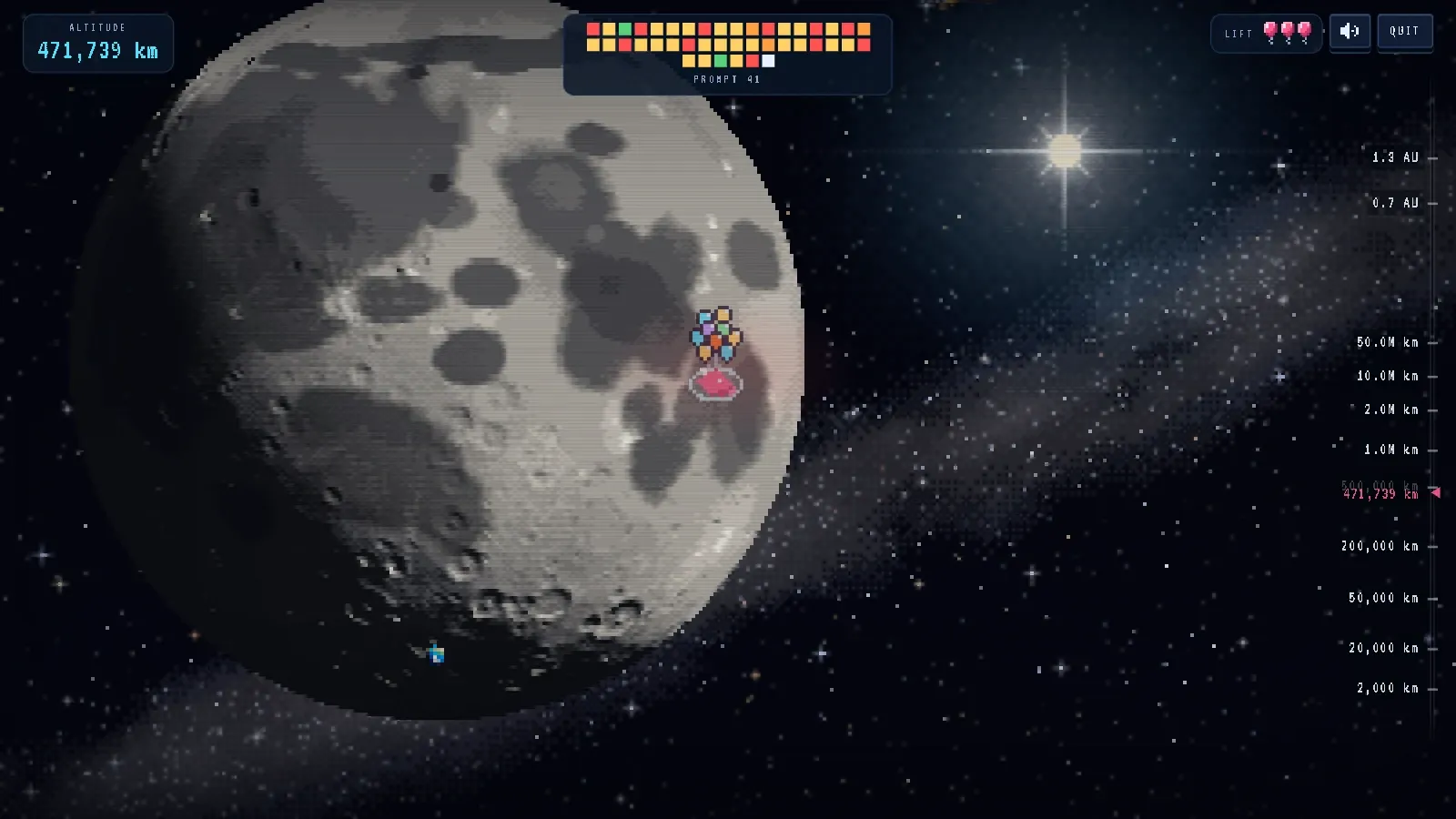
- 24. The Moon, from 3,220 points, 350,000 km to 600,000 km. The only other world a person has ever stood on.
- 25. L2, from 3,450 points, 600,000 km to 2 million km. A gravity balance point, a million and a half kilometres out.
- 26. Venus, from 3,700 points, 2 million km to 50 million km. Earth's nearest planetary neighbour, wrapped in cloud that never breaks.
- 27. Mars, from 4,000 points, 50 million km to 70 million km. Rust-red, half the size of Earth, and the next place anyone might stand.
- 28. Mercury, from 4,300 points, 70 million km to 0.7 AU. A scorched, airless rock, closest to the Sun of anything here.
- 29. The Sun, from 4,620 points, 0.7 AU to 2 AU. A fusion reaction, ninety three million miles across the gap.
- 30. The Asteroid Belt, from 5,020 points, 2 AU to 3 AU. Rubble left over from a planet that never finished forming.
- 31. Jupiter, from 5,350 points, 3 AU to 4.7 AU. Bigger than every other planet put together, with storms older than nations.
- 32. Saturn, from 5,750 points, 4.7 AU to 8.7 AU. Rings of ice and rock, thin enough to see stars straight through.
- 33. Uranus, from 6,150 points, 8.7 AU to 18 AU. Tipped on its side, pale blue-green, and colder than it should be.
- 34. Neptune, from 6,550 points, 18 AU to 30 AU. The windiest planet, and the last one anybody agrees is a planet.
- 35. Pluto and the Kuiper Belt, from 6,950 points, 30 AU to 50 AU. A belt of icy leftovers, with a dwarf planet for a signpost.
- 36. The Heliopause, from 7,350 points, 50 AU to 2,000 AU. Past this, the Sun stops pushing back against everything else.
- 37. The Oort Cloud, from 7,800 points, 2,000 AU to 1.5 light years. A shell of comets asleep in the cold, a light-year thick.
The Stars and the Galaxies
Past the Oort cloud the distances are in light years, and the zones are the places astronomers can actually see: the nearest stars, the nebulae where new ones form, the black hole at the centre of the Milky Way, the neighbouring galaxies and, last, the oldest light there is.
- 38. Alpha Centauri, from 8,200 points, 1.5 light years to 4.4 light years. The nearest other stars there are. Still four years away at light speed.
- 39. Sirius and the Neighbours, from 8,500 points, 4.4 light years to 10 light years. The brightest star in the sky, and the ordinary ones near it.
- 40. The Pleiades, from 8,920 points, 10 light years to 460 light years. Seven sisters, or a few hundred, depending how you count.
- 41. Betelgeuse, from 9,380 points, 460 light years to 560 light years. A red giant, swollen and dying. By the time we see it, it may already be gone.
- 42. The Orion Nebula, from 9,880 points, 560 light years to 1,400 light years. A nursery. Stars are being born inside it, right now.
- 43. The Pillars of Creation, from 10,380 points, 1,400 light years to 6,600 light years. Towers of gas and dust, lit from one side by the stars they are building.
- 44. The Orion Arm, from 10,900 points, 6,600 light years to 20,000 light years. One loose spur of the galaxy. This has always been the neighbourhood.
- 45. Sagittarius A*, from 11,420 points, 20,000 light years to 27,000 light years. A black hole four million times the Sun's mass, at the centre of it all.
- 46. The Halo, from 11,960 points, 27,000 light years to 50,000 light years. Old, spherical swarms of stars, orbiting far above and below the disc.
- 47. The Milky Way, Seen Whole, from 12,500 points, 50,000 light years to 100,000 light years. Far enough now to see the whole galaxy at once, from the outside.
- 48. The Magellanic Clouds, from 13,060 points, 100,000 light years to 160,000 light years. Two small galaxies, caught orbiting a much bigger one.
- 49. Andromeda, from 13,620 points, 160,000 light years to 2.5 million light years. The nearest big galaxy, closing in, slowly, to meet this one.
- 50. The Virgo Cluster, from 14,200 points, 2.5 million light years to 54 million light years. Thousands of galaxies, held together by their own gravity.
- 51. The Cosmic Web, from 14,800 points, 54 million light years to 1 billion light years. Galaxies strung out along filaments, with vast empty voids between.
- 52. The Last Light, from 15,400 points, 1 billion light years to 46.5 billion light years. The oldest light there is, nearly 13.8 billion years on its way here.
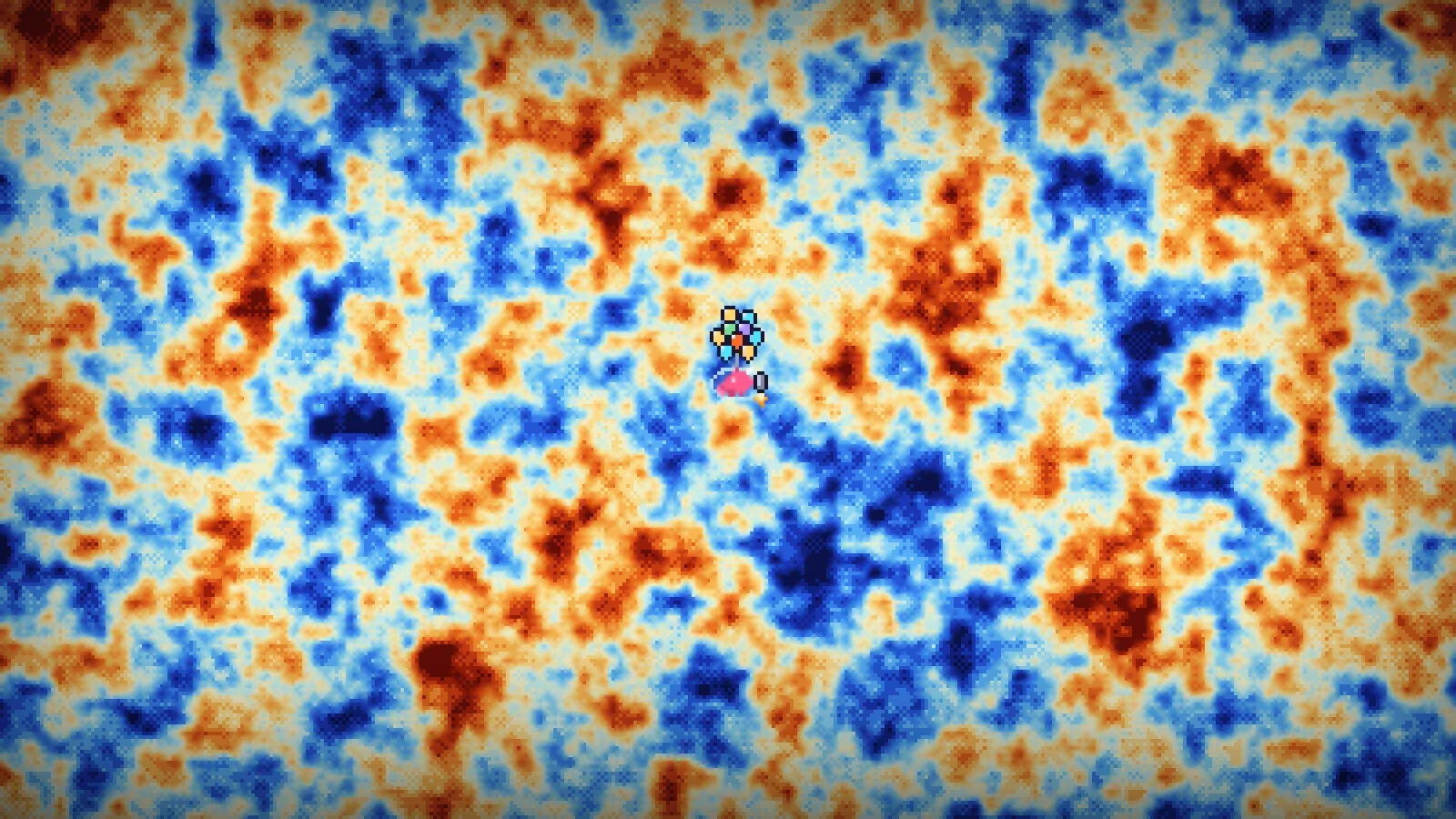
The Last Light is the edge of the observable universe. Light from anything farther has not had time to reach us, so nothing past it can be measured. Reaching it takes 15,400 points.
Past the Last Light
From 16,000 points the game leaves facts behind on purpose. The climb goes through a time warp and on through universe after universe, each with something of its own: an ocean under rings of ice, a world of glass, whales that swim between the stars, a frozen universe, and one civilisation traced from the shipyard it abandoned to the shell it built round its own star. The altitude keeps counting, in powers of ten, up to a googol light years.
- 53. The Horizon, from 16,000 points, 46.5 billion light years to 62 billion light years. As far as light has had time to come. The universe does not stop here.
- 54. The Time Warp, from 17,000 points, 62 billion light years to 10 trillion light years. Space bent so far it folds back on itself. The light here left tomorrow.
- 55. The Ringed Ocean, from 18,100 points, 10 trillion light years to 10¹⁸ light years. Another universe, another sea: one ocean round the whole world, under rings of ice.
- 56. The Glass World, from 19,200 points, 10¹⁸ light years to 10²³ light years. A world that set like glass. Starlight goes in white and comes out in colours.
- 57. The Star Whales, from 20,300 points, 10²³ light years to 10²⁸ light years. Something lives out here, between the stars. It is very big, and very slow, and it glows.
- 58. The Fire World, from 21,400 points, 10²⁸ light years to 10³³ light years. Too close to its star. The ground has cracked open, and fire runs in the cracks.
- 59. The Storm Giant, from 22,500 points, 10³³ light years to 10³⁸ light years. A giant of a planet, its storms wide enough to swallow whole Earths.
- 60. The Twin Worlds, from 23,600 points, 10³⁸ light years to 10⁴³ light years. Two worlds, so close they share their air.
- 61. Frozen Space, from 24,700 points, 10⁴³ light years to 10⁴⁸ light years. A universe so cold that space itself froze. Its last world, frozen through, still breathing out ice.
- 62. The Broken World, from 25,800 points, 10⁴⁸ light years to 10⁵³ light years. A world that came apart. Its heart still glows where the pieces left.
- 63. The Shipyard, from 26,900 points, 10⁵³ light years to 10⁵⁸ light years. Somebody was building ships here, enormous ones. They left in a hurry, and never came back.
- 64. The City World, from 28,000 points, 10⁵⁸ light years to 10⁶³ light years. A whole world built over, pole to pole. Somebody lives here. A great many somebodies.
- 65. The Ringworld, from 29,100 points, 10⁶³ light years to 10⁶⁸ light years. They built a ring round their star, as long as an orbit, and live on the inside of it.
- 66. The Dyson Sphere, from 30,200 points, 10⁶⁸ light years to 10⁷³ light years. In the end they wrapped their star up whole, to keep every bit of its light. A little leaks out.
- 67. The Black Sun, from 31,300 points, 10⁷³ light years to 10⁷⁸ light years. A world circling a black hole, lit by everything falling in.
- 68. The Garden World, from 32,400 points, 10⁷⁸ light years to 10⁸⁴ light years. A universe where life took everything. Even the night side glows.
- 69. All There Is, from 33,500 points, 10⁸⁴ light years to 10¹⁰⁰ light years. Every world, in every universe, round one light. And still it goes on.
All There Is starts at 33,500 points, and the top of the world is 35,500. Past it the altitude keeps rising tenfold every thousand points, so in a multiplayer room, where a sitting's height carries on from climb to climb, a higher score always reads higher.
How Far Can You Really Get?
A Sky High answer is worth 100 points, so in Sky Highs alone: the edge of space is 18 in a row, the Moon 33, the Last Light 154 and All There Is 335. In Endless mode you start with three balloons, a miss pops one and every Sky High gives one back, so a long climb needs a player who almost never lets the clock run out and often finds the top answer. Our Noillirk tips are about doing exactly that.
The other way up is a long sitting in a multiplayer room, where each climb starts where the last one ended. A few Marathon climbs of 50 prompts can carry you well into the solar system. Here is how the rooms work.
Every one of these zones is in the official game at playdaily.org, and only there (here is how to tell). Start at the pond.
About the author
Timmothy is a student who has loved puzzle games since childhood and likes digging into how they actually work. He writes about the science and history behind the games on Daily.